After Gold ATR Rises, Is a Fixed-Distance Stop Still Appropriate? Check the Risk Budget First
ATR measures volatility, not direction. When volatility expands, first check the structural invalidation point, stop distance, and position size to avoid unintentionally increasing risk per trade.
Author: Thomas | Technical Analysis | November 4, 2026
Summary: When gold's intraday volatility suddenly expands, could a stop originally set at a fixed dollar distance become too close? ATR can be used to check the volatility scale, but ATR cannot tell you whether gold will go up or down next. This article discusses a practical issue: when ATR rises, how to avoid mistaking normal volatility for a failure of the trading logic while maintaining a pre-set risk budget. The image is an original educational illustration, not real market data.
ATR Answers Volatility, Not Direction
True Range (TR) takes the maximum of three values: the current high minus the current low, the absolute value of the current high minus the previous close, and the absolute value of the current low minus the previous close. ATR is a period average of TR. It incorporates gaps across periods into the volatility estimate. The commonly used 14 periods is only a starting parameter; the 15-minute ATR and daily ATR of the same instrument cannot be used interchangeably. MetaTrader's official help classifies ATR as a volatility indicator, and its rise cannot be used to directly infer "should go long" or "should go short."
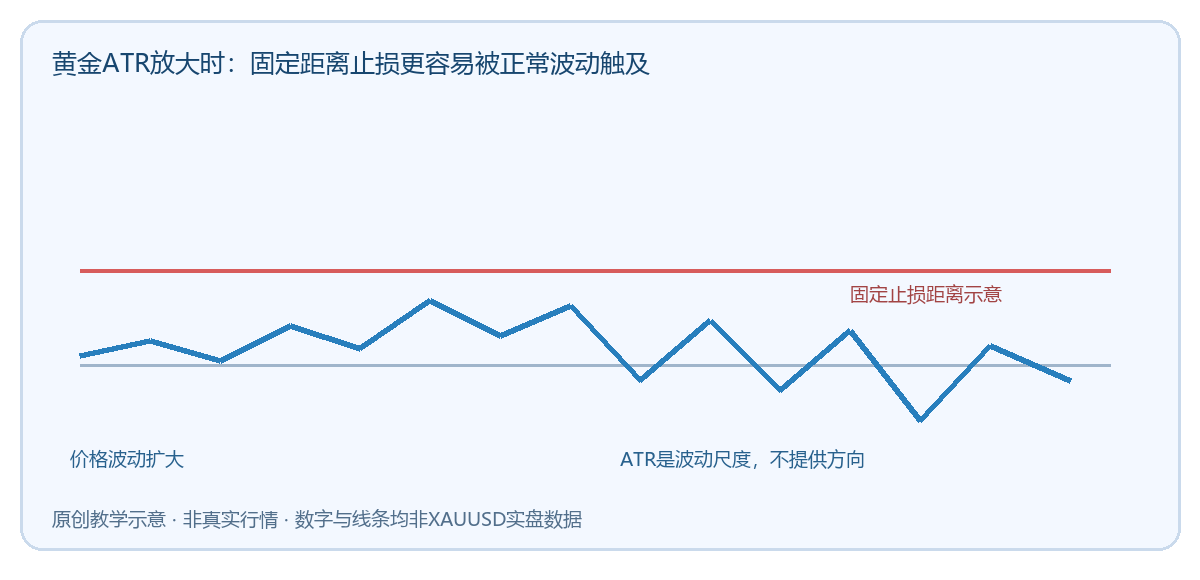
In the chart, the blue line's up-and-down swings gradually widen, while the red line represents a pre-fixed distance. After volatility increases, the same fixed distance is more easily touched by ordinary price swings. This only indicates that "the relationship between stop placement and market noise" may change; it does not mean the stop should automatically be widened. Widening the stop while keeping lot size unchanged will increase the possible loss per trade; if the account's risk budget cannot bear it, reduce the lot size or abandon the plan for this trade.
Four Steps to Check a Gold Trade
Step one: fix the data conventions. Record the broker used for XAUUSD, contract suffix, candlestick timeframe, ATR parameters, quote time, and time zone. Different platforms have different high/low prices and daily rollover times, so ATR will also differ. Do not use a website's daily ATR to adjust short-term pending orders in another account.
Step two: first define the trade invalidation point. For example, if the reason for a trade is "a pullback holds above the previous structural low," then breaking below that low and failing to recover is a candidate condition for logic invalidation. ATR can help judge whether that structural point is too close to the entry price, but it cannot replace the structure itself. If the entry point is too close to the invalidation point, ordinary volatility may cause the stop to be triggered frequently.
Step three: check the risk amount and lot size. Teaching example: assume the account pre-sets a maximum risk of 100 USD for one trade, and the original stop distance corresponds to 50 USD risk per lot, so a maximum of 2 lots is only an arithmetic result; if after volatility increases the reasonable distance corresponds to 100 USD risk per lot, still opening 2 lots would push the risk to 200 USD. The numbers do not account for spread, slippage, or actual XAUUSD contract units, and do not represent the lot size available on any platform. Actual calculations should be based on account specifications and executable quotes.
Step four: record abnormal periods. During U.S. data releases, election news, or low liquidity, ATR may rise quickly, and spreads and slippage may also widen at the same time. The stop trigger price does not guarantee the final execution price. If real-time conditions differ too much from backtest assumptions, pausing execution and recalculating risk is more prudent than mechanically applying "1x ATR" or "2x ATR."
How to Identify Common Failure Cases
One common mistake is continuously moving the stop in the direction of loss after ATR rises without adjusting position size, causing losses to exceed the plan. Another is setting the stop too tight when ATR is very low, ignoring spreads and normal volatility across trading sessions. Some also conclude that a breakout is imminent when they see ATR decline; low volatility can persist, and ATR cannot determine the breakout direction. During backtesting, record different volatility environments, trading costs, post-trigger slippage, and invalidation scenarios at the same time. If parameters are only effective in a short historical segment, the conditions for practical use are not robust enough. This article is for technical analysis education only and does not constitute trading advice or any guarantee of returns.

MT4 EA troubleshooting guides →